The page this skill built from examples/ivy, working in your browser. Opens in a new tab. Also: .
22-second example rendered by this skill from examples/ivy · 1280×720
What you get
- A self-contained portfolio page built from one portrait.json, with your frames beside it
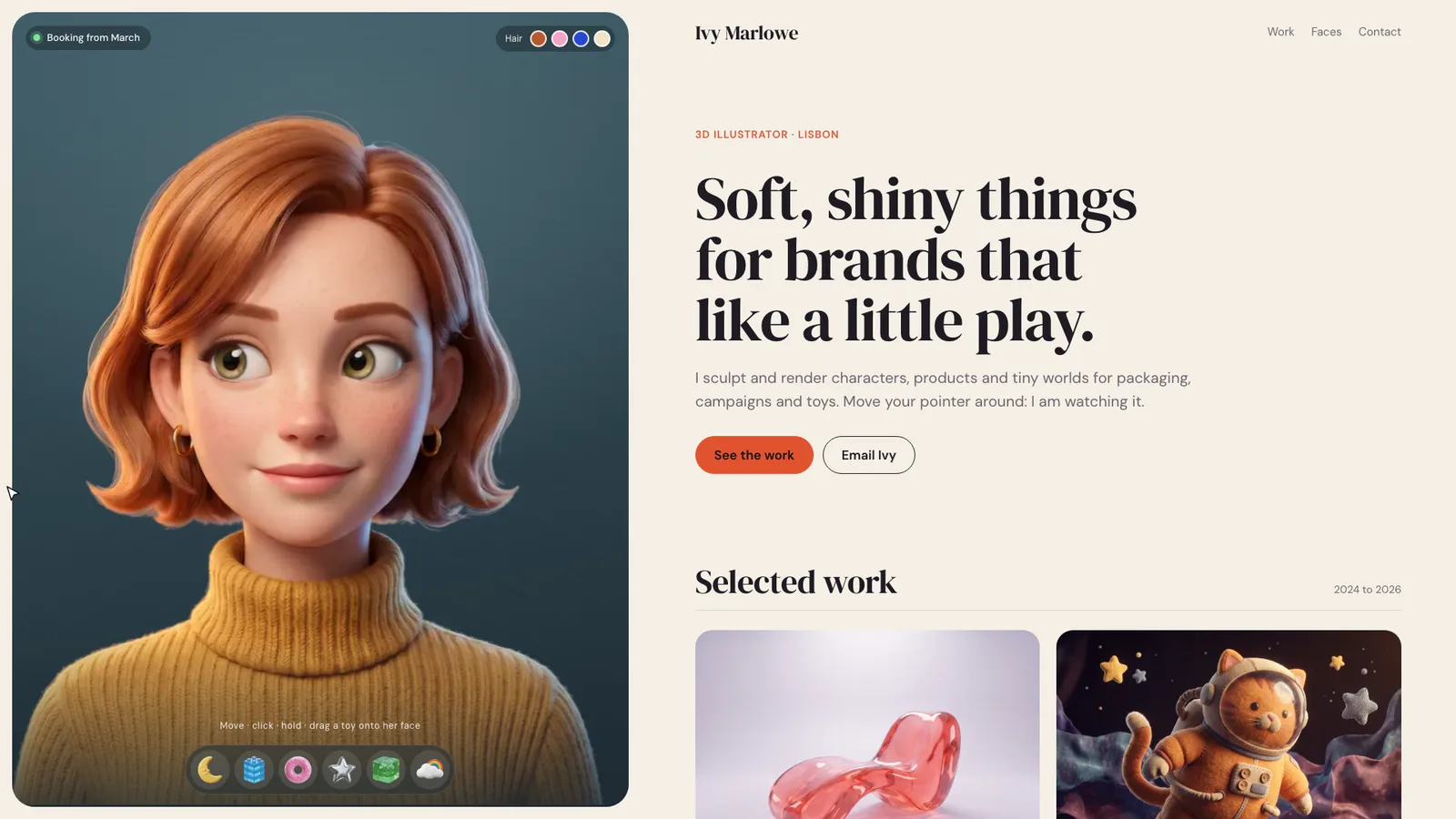
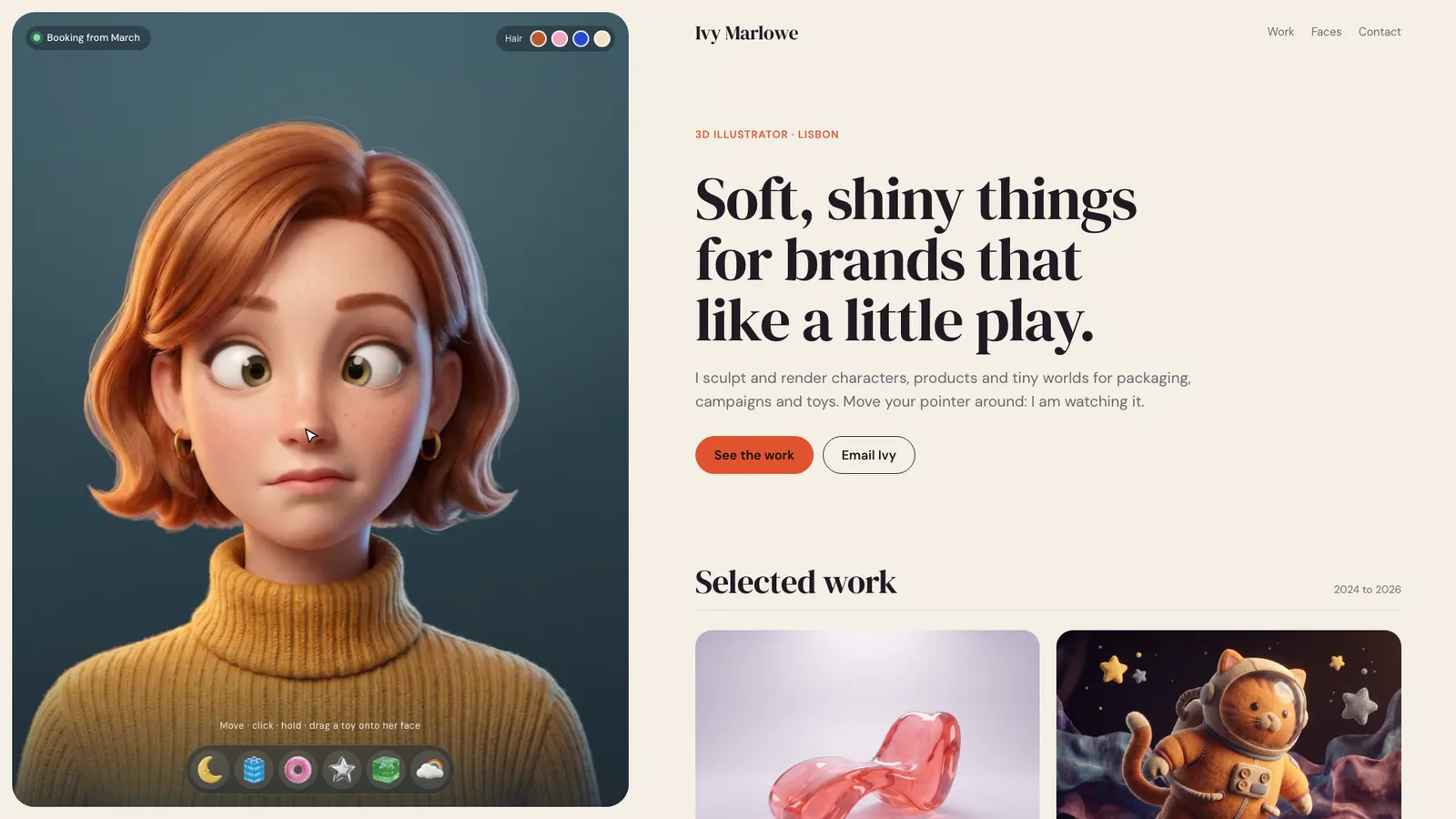
- Eyes that follow the pointer, using the measured direction of each gaze frame, plus blinks
- A reaction and a line for every piece of work, pokes, a bubble-gum long press, toys to throw, hair colours and a doze
- A frame script that lines up your pictures, removes the flat background without a halo and finds the eyes
- A phone layout with a small reacting face that follows you down the page
- A visitor check that plays every reaction at desktop and phone sizes
- 2 examples: a light illustrator page and a dark product designer page
- Open-source licenses for every part it builds on
Good fit
- An illustrator, 3D artist or designer who wants clients to remember the person behind the work.
- A creator, coach or streamer whose about page should feel like meeting them.
- A studio or brand with a mascot that should greet visitors and react to products.
Not for
- Making the faces: every frame is a picture you supply or generate
- Talking or lip-sync: the portrait swaps still frames, it does not animate a mouth
- Photos where the head moves between frames: they have to line up
About this skill
A one-person portfolio page whose portrait is alive. The person stands in a tall stage beside the scrolling page, built from a stack of still frames from one sitting, lined up to the pixel and swapped instantly. The eyes follow the pointer, using gaze directions measured from the pictures themselves, and cross when you point at the nose. They blink on their own. Every piece of work gets its own face and a line in a speech bubble when you point at it. A click pokes, a long press blows a bubble-gum bubble until it pops, and circling the face makes it dizzy. Toys can be thrown or dragged onto the face, hair swatches try on colours, and left alone the portrait yawns and dozes off. On phones a small round face keeps reacting in the corner. Your agent lines up and cuts out your frames, writes one portrait.json and builds a single page, then plays every reaction in headless Chrome.
Example request
Build my portfolio page with a portrait of me that follows the cursor and reacts to each project, from these frames of my face.
How it works
Your agent
- 1
Collect the person, the work and the voice
Never invent clients, years or quotes for a real person: ask.
- 2
Make or collect the frames
Name the files
<prefix><name>.png(or.jpg) in one folder:rest,half,closed,g-e,g-ne,g-n... - 3
Line up and cut out the frames
It checks every frame is the size of
rest, lines each one up withrestand prints amatchscore (it warns under 0.9: that frame will jump when swapped), removes the flat background with a soft edge that carries no grey halo, gives every frame whose outline matchesrestexactly the same matte (so the edge never shimmers while the eyes move), crops all of them to one box and writes<name>.webp(760 px tall),thumbs/<name>.webp(the face, 160 px) andframes.json. - 4
Write portrait.json
Copy
examples/ivy/portrait.json(light page, stage on the left) orexamples/otis/portrait.json(dark page, stage on the right) next to theassetsfolder and replace everything. - 5
Build
The build checks every field and length, that every picture exists, that every reaction names a frame that is in frames.json, that there are at least four gaze directions, and that the colours read (ink on page 7:1, muted 4.5:1, white on the dark stage colour 4.5:1).
- 6
Check it
It plays the page in headless Chrome at 1440 x 900, 1920 x 1080 and 390 x 844: all frames load; nothing scrolls sideways or spills out of its box; the eyes reach at least four gaze frames as the pointer goes round the face; the nose crosses them; every work card, face chip and prop gives its reaction; a click pokes; a long press pops the bubble; a dragged toy lands; she dozes off when left alone and wakes; on a phone the small host appears and a tapped card reacts.
- 1
You get
- out/index.html
What you need
- Node.js 18 or newer, for the build. Nothing to install.
- Python 3 with
pip install pillow numpy, forscripts/prepare.pyandscripts/stills.py. - 20 to 60 frames of one person, same camera, same framing, same lighting, a plain flat background, only the face changing: one calm
restframe looking into the lens, eight or more gaze frames (g-*, only the eyes move),halfandclosedfor blinking, and as many expressions as you like. An image model can make them: generate the rest picture, then ask for edits of it that change only the eyes or the expression (the prompts that made the examples are inexamples/PROMPTS.md). A photographer on a tripod with fixed light works too. - The work pictures (any shape; they are shown 4:3) and, if you want the toy tray, up to six pictures of single objects on a plain background.
- Playwright with Chromium (
npm i -D playwright && npx playwright install chromium) forscripts/check.mjs. Any browser opens the page. - Internet when the page is opened, for the Google Fonts. Without it the page uses system fonts.
Last checked Nov 24, 2026: the package’s own build and render commands ran and passed.
If something goes wrong
A frame jumps when it swaps in
Its head or shoulders moved.
prepare.pyprintsmatchper frame and warns under 0.9; regenerate or reshoot that frame from the rest picture, or leave it out with--skip.The eyes look the wrong way for one direction
That gaze frame's eyes moved less, or differently, than its name says. The page already uses the measured direction; if it still looks off, drop the frame with
--skip. The eyes need at least four directions, ideally left, right, up and down.A grey or light outline around the hair
It is usually the rim light of the original picture. Pick a mid or dark stage colour, which makes it read as light; on a pale stage it reads as a halo.
What’s in the download
- SKILL.md12.9 KBthese instructions.
- examples/
- examples/ivy/9.24 KB2 files
- examples/otis/9.34 KB2 files
- examples/PROMPTS.md13.5 KBthe image prompts that made the example frames, work and toys.
- scripts/
- scripts/build.mjs13.1 KBchecks portrait.json against frames.json and writes the page.
- scripts/check.mjs8.93 KBplays every reaction in headless Chrome at desktop and phone sizes and checks the layout.
- scripts/prepare.py13.3 KBlines up the frames with the rest frame, cuts them out of the flat background, measures where every gaze frame looks and writes the pictures, the face thumbnails and frames.json.
- scripts/stills.py3.44 KBresizes the work pictures and cuts the toys out of their background.
- template/
- template/page.html30.9 KBthe page itself (layout, stage, frame stack, gaze, reactions, toys, phone host), filled in by the build.
- NOTICE.md1.12 KB
- TESTED.json821 B
13 files · 117 KB · installs to ~/.claude/skills/living-portrait for Claude Code and ~/.agents/skills/living-portrait for other agents
Credits and licenses: NOTICE.md plus any LICENSE files inside the ZIP.
Similar Skills
View allDetails
- Output
- Portfolio page · portrait that watches the pointer and reacts · page from portrait.json
- Needs
- Node.js 18+; Python 3 with Pillow and NumPy; 20 to 60 frames of one face on a plain background; Playwright with Chrome for the check
- Series
- Page Kits · 35 skills
- Updated
- Nov 24, 2026
- Checked
- Nov 24, 2026: its own commands ran and passed. That is a working check, not a security audit.
Written for
See all 31 agents that read skill folders.
Install guides
For your agent
Generates with
Installed it? Tell others how it went. Reviews come from people who installed this skill.
Write a reviewFAQ
How do the eyes know where to look?
Each gaze frame is compared with the calm frame inside the eyes, and the script measures where the iris went. The page then shows the frame whose measured direction points closest to the pointer, so a frame that came out wrong never looks the wrong way.
Where do the frames come from?
From you: photos on a tripod with fixed light, or an image model making one calm picture and then edits of it that change only the eyes or the expression. The included script lines them up, removes the flat background and says when a frame moved.
Does it work on phones?
Yes. The portrait sits at the top with the toy tray, cards react when tapped, and once the portrait scrolls away a small round copy of the face stays in the corner and keeps reacting with its own speech bubble.
Which agents is Living Portrait written for?
Any agent that reads SKILL.md folders, including Claude Code, Codex, Cursor, GitHub Copilot, Gemini CLI and OpenCode.
Do I own what I make with it?
Yes. Everything your agent makes with this skill is yours, including for client and commercial work.
What if it doesn’t work for me?
Email support@lookbk.dev within 7 days of buying and we’ll fix it or refund you.
Credits and licensesWritten by Lookbk
Lookbk wrote this package: the page, its frame stack and reactions, the build, the alignment, cut-out and gaze measurement script and the visitor check. The example people, work and toys were generated with Gemini for Lookbk; no third-party code ships in the page. Written by Lookbk, no third-party code.
Credits and licenses for the open-source software and fonts it uses are in NOTICE.md inside the download.